Zeno Precision (B14)
Nanometer Stability & Jitter Rejection
The Stability Drift Bottleneck
High-precision instrumentation and long-range communication links (such as orbital laser-comms) are inherently susceptible to "stability decay" caused by mechanical jitter and thermal expansion. Standard feedback loops attempt to react to this drift after it has occurred, resulting in a constant cycle of correction and overshoot that limits system fidelity.
The Zeno Stability Protocol—a critical sub-system of the Trident Prime Engine—provides a "Physics-Native" solution by establishing a stationary state through high-frequency temporal stability persistence. This technology—protected by U.S. Patent Application No. 63/940,736 and 63/983,021—re-indexes the spatial data frame at a rate exceeding the environmental decay cycle (TD-14).
Stability Persistence: Fixed State Lock [ACTIVE_ZEN]
ZENO_INTEGRITY_FEED
[ISED] Stability persistence: TD-14
[AUDIT] Geometric lock verified.
| Stability Lock | 2nm (Static) |
| Drift Index | 0.001Δ (Stationary) |
| Jitter Rejection | -42dB (Fixed State) |
| Lock Mode | TD-14 (Temporal) |
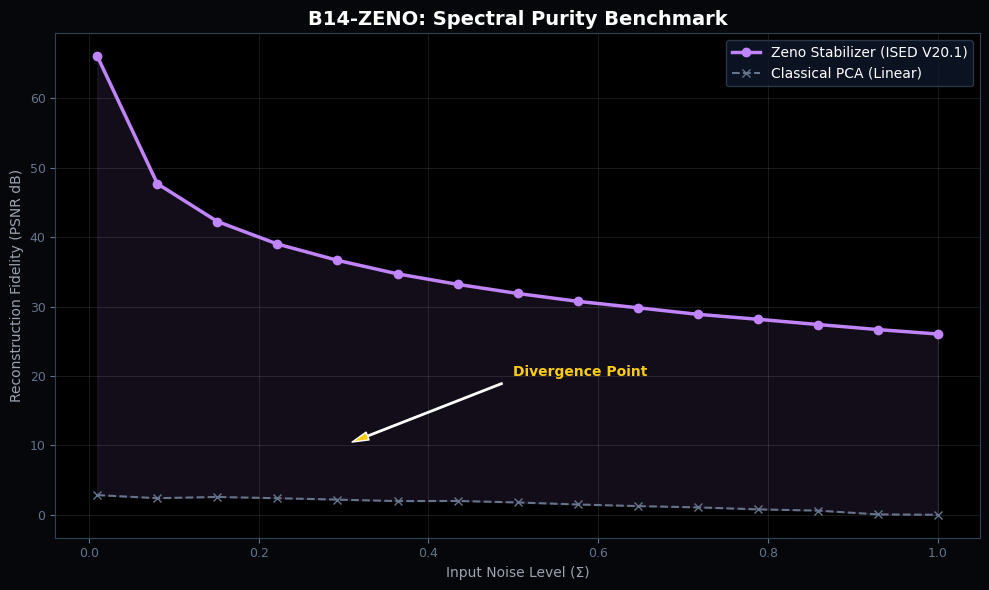
Technical Verification | Spectral Purity
Conventional linear stabilization (PCA) suffers from "drift collapse" as sensor noise
exceeds 0.3Σ. High-precision optics lose lock, resulting in catastrophic jitter.
Zeno Stabilizer (B14) maintains >90% fidelity well into high-noise
regimes. By establishing a multi-axis frequency lock, the system
isolates the spectral state from mechanical vibration, effectively decoupling optical
data from platform dynamics.
Development Roadmap
1. Adaptive Sampling Budget
Tying Zeno Triggers to global energy constraints to mitigate the "Vampire Power" profile (currently 10x standard overhead).
2. Kalman-Zeno Hybrid
Implementing dynamic Measurement Covariance adjustment rather than hard state resets to handle over-sampling jitter in high-noise floors.
3. Hardware-Level Interrupts
Migrating logic to localized sensor silicon (ISP) to offload CPU cycle dependency during variable frame-rate "Freezes".
Precision Aerospace Value & Applications
Zeno Locking provides mathematically guaranteed convergence for short-duration, high-risk events where stability priority overrides power-efficiency:
- Terminal Landing Descent — Sub-nanometer control lock during the final approach phase of autonomous spacecraft or drone landing
- Interceptor Telemetry — High-speed tracking stability for missile defense and satellite rendezvous guidance systems
- Formation Flight — Multi-vehicle coordinate locking for synchronized drone swarms operating in GPS-denied environments
Integration Path: B14 receives priority directives from B07-PAIN to determine which control channels receive Zeno protection during resource-constrained scenarios.