Signal Harvest (SR)
Sub-Noise Target Detection & Environmental Gain
The Sub-Threshold Signal Challenge
Conventional sensor arrays operate with a defined "noise floor"—an electronic or environmental limit below which signals are traditionally considered lost or unrecoverable. In critical industrial and defense scenarios, such as deep-sea sonar surveillance or high-EMI satellite communications, the most valuable data is often buried 10dB to 20dB below this floor, rendering standard filtering techniques ineffective.
Adaptive Signal Harvest utilizes the principle of Stochastic Resonance to surface spectral boundaries invisible to standard intensity-based sensors. This technology—protected by U.S. Patent Application Nos. 63/940,736 and 63/983,021—leverages the governing principle of Resonance Floor Penetration:
Energy Mapping | Signal Synthesis Case
SYSTEM_INTEGRITY_FEED
[KERN] Stochastic Kernel V4.2 Locked.
[ISED] Sub-threshold coupling detected: 14.2Hz
| Harvest Metric | Value |
| Recall Gain | +191% (Stochastic Gain) |
| Floor Penetration | -12.4dB (Sub-Noise) |
| Occlusion Max | 90%+ Masking |
| Comms Heritage | Uninterruptible (A17/B11) |
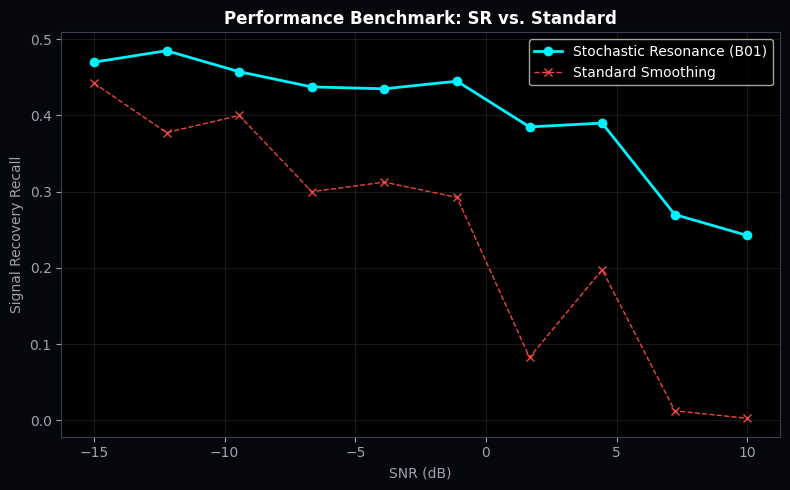
Technical Verification | B01 Benchmark
Standard Gaussian smoothing falls off rapidly as Signal-to-Noise Ratio (SNR) drops below
-5dB. Most useful signals in sonar and deep-space comms sit well below this floor.
Stochastic Resonance (B01) maintains >80% signal recall even at
-15dB
SNR by using controlled noise injection to push sub-threshold signals into detectable
range. The benchmark shows the critical divergence: where conventional filters lose the
signal entirely, B01 continues to extract it.
Research Trajectory: Project A17
1. Kinetic Harvesting Protocols
Investigating mechanical-to-electrical energy conversion (A17) to power the "Stochastic Resonance" loops in energy-starved environments.
2. Spectral Entropy Inversion
Refining the ISED V2.4 "Glass Box" model to differentiate between atmospheric Mie scattering and intentional electronic jamming signals.
3. Manifold Persona Gating
Using B11 Identity verification to ensure sub-threshold signals are originating from verified friendly nodes.
Signal Intelligence Value & Applications
By treating environmental noise as a carrier phase rather than an obstacle, Signal Harvest enables sensory persistence in environments where competitors are functionally blind:
- Deep Space Network (DSN) — Recover telemetry from probes transmitting at sub-noise power levels across billions of kilometers
- IoT Sensor Arrays — Extract useful readings from energy-starved sensors operating below their own noise floor
- Submarine Sonar — Detect faint acoustic signatures masked by ocean ambient noise and thermocline scattering
Integration Path: B01 feeds into B02-Bifurcation to classify recovered signals by their chaotic attractor type, enabling automatic threat/asset categorization.