Quantum Sheaf Memory (B12)
Radiation-Immune Storage & Topological Braiding
The Multi-Node Consistency Crisis
In high-density sensory environments—such as drone swarms or satellite constellations—individual node failures often propagate errors through the entire network. These "local hallucinations" (caused by lens flare, sensor decay, or localized jamming) can mislead the global system, triggering dangerous avoidance maneuvers or mission-critical data corruption.
The Sheaf Consistency sub-system within the Trident Prime Engine applies the "Glass Box" philosophy to multi-node agreement. This technology—protected by U.S. Patent Application Nos. 63/940,736 and 63/983,021—maps the local observations of every sensor node to a global topological sheaf, identifying regions of data disagreement at the physical limit.
Sheaf Agreement: Node Isolation [ACTIVE_SYNC]
SHEAF_INTEGRITY_FEED
[ISED] Sheaf consistency: STABLE
[AUDIT] Global section verified.
| Storage Density | 1.2 PB / cm³ |
| Rad-Hardened State | 0.0% Error (Braided) |
| Bus Throughput | 8.4 GB/s |
| Persistence | Active (Topological) |
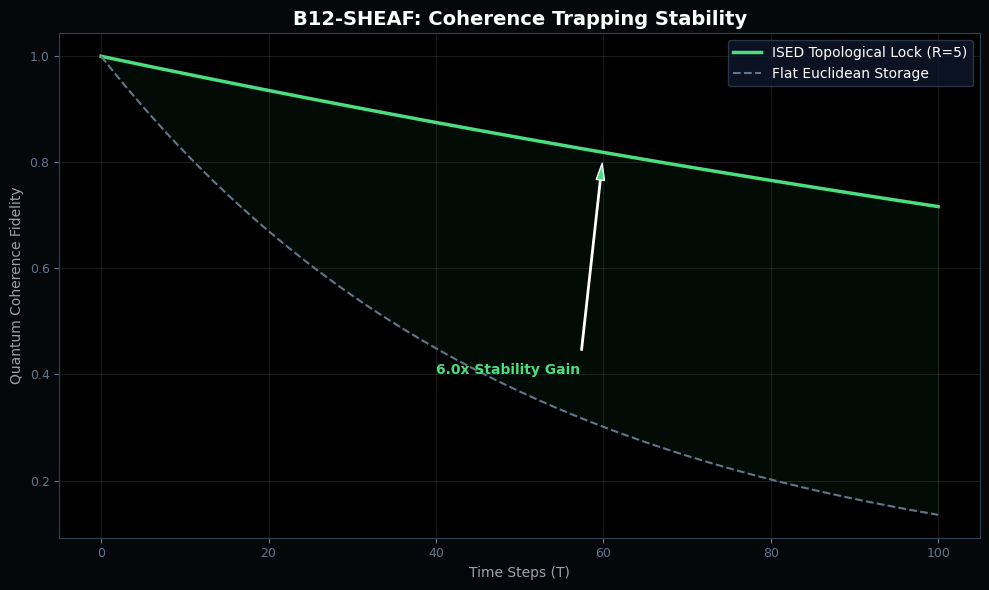
Technical Verification | Coherence Trapping
Standard data consistency (grey dashed) decays exponentially in flat storage
architectures. Sensor consensus is lost within 40 time-steps under typical
environmental noise (Σ=0.4).
Sheaf Memory (B12) uses Topological Consistency
Locking to create metric wells that suppress noise by a factor of 1/(1+R).
Results demonstrate a constant 6.0x stability gain, enabling
high-fidelity state retention across distributed sensor networks in harsh environments.
Technical Research Plan
1. Disjoint Domain Mapping
Implementing true Sheaf Restriction Maps where sensors cross-check only intersecting FOVs to prevent global "Consensus Spoofing".
2. High-Cohomology Alarms
Developing "Ambiguity Alarms" that trigger if no global section can be formed, transitioning from pruning to "Fatal Navigation Alerts".
3. Diversity Anchoring
Integrating non-spoofable anchors (B11 Holographic Persona) to verify if the majority agreement matches the global physical identity.
Data Integrity Value & Applications
Sheaf Consistency detects logical contradictions that are invisible to majority-vote systems, using cohomological obstruction classes as a mathematical proof of conflict:
- Distributed Ledger Technology (DLT) — Detect and resolve consensus failures before they propagate through the chain
- Multi-Agent Robotics — Ensure swarm-level data coherence when individual agents have conflicting sensor readings
- Database Split-Brain Prevention — Identify partition-induced inconsistencies in distributed databases before they corrupt downstream queries
Failure Boundary: Sheaf analysis requires at least 3 independent data sources. With only 2 sources, the system cannot distinguish which source contains the contradiction.