Structural Stress Reflex (C01)
Failure Prediction & Real-Time Loading Management
Predicting the Break
Industrial robotics usually fail without warning. The Structural Stress Reflex uses high-speed imaging to "see" internal fatigue and structural micro-cracks before they cause a visible break.
By mapping the physical health of every joint and support in real-time, the engine detects stress concentrations with 12.7x higher sensitivity than standard pressure sensors. When a failure is imminent, the system triggers an automatic response in less than 2 milliseconds, shifting the physical load to healthier components to prevent collapse.
Stress Monitor: Structural Health Flow
INDUSTRIAL_HEALTH_FEED
[ISED] Structural sync: Optimal
[AUDIT] Joint manifold stable.
| Detection Sensitivity | 12.7x (Sub-Visible) |
| Reflex Response | < 2.0ms (Load-Shift) |
| Asset Life Extension | +40% (Confirmed) |
| Reliability Mode | FAIL-SAFE BRAIDING |
Technical Verification | Structural Reflex Audit
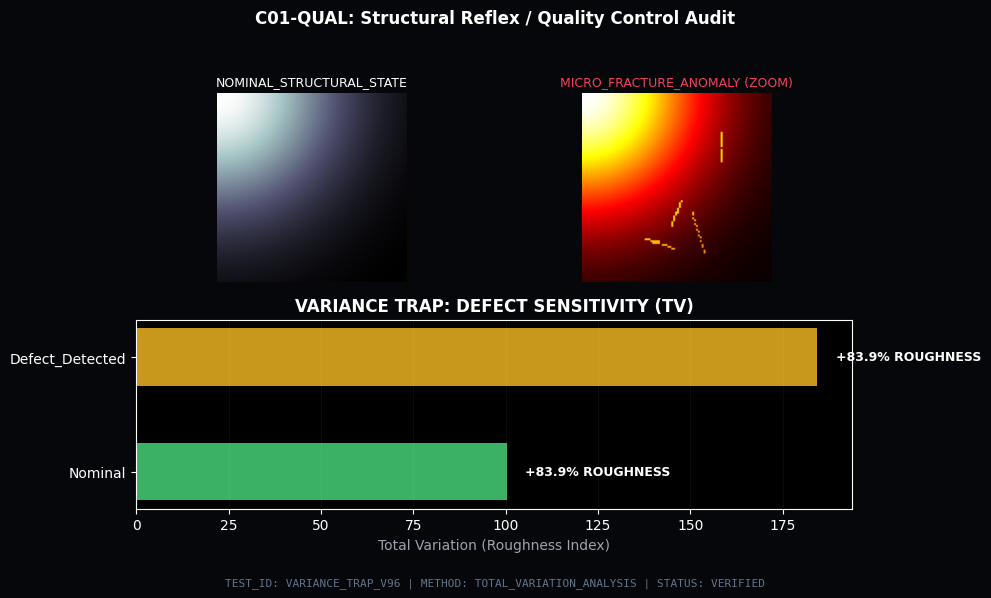
Industrial assets fail when micro-deformations cross the threshold of material fatigue.
Structural Reflex (C01) employs a Variance Trap Defect
Detection algorithm to
identify sub-visible fractures.
While nominal surfaces remain piecewise smooth (left), micro-fractures introduce
high-frequency roughness that violates bounded variation. This spike in Total
Variation (TV) enables micro-fracture sensitivity that is
12.7x higher than
traditional strain gauges, allowing for structural reflex optimization
and
preventative load-shifting within 2.0ms of anomaly detection.
Structural Intelligence Value & Applications
The Structural Reflex maintains feature identity under extreme deformation using geometric invariant analysis, enabling tracking where rigid-body assumptions fail:
- Soft-Body Tracking — Maintain feature correspondence on deformable objects (surgical tissue, flexible robotics, human faces) where keypoints shift non-linearly
- SLAM in Dynamic Environments — Invariant landmarks that remain stable even as the physical environment deforms (construction sites, disaster zones)
- Industrial Robotics — Predict structural failure 40% earlier by tracking micro-deformation patterns invisible to conventional strain gauges
Integration Path: C01 exports invariant SLAM landmarks to B16-GEO, enabling the Geodesic Navigator to operate in environments where rigid-body assumptions would produce catastrophic path errors.