Volumetric VFX (OMEGA)
Real-Time 3D Scene Generation & Cinematic Reconstruction
Eliminating CGI Bottlenecks
Standard video production is restricted to two dimensions. Converting flat footage into 3D environments normally takes weeks of manual CGI labor, expensive LIDAR rigs, and massive rendering budgets.
The OMEGA Engine enables Instant Spatial Reconstruction. This technology—protected by U.S. Patent Application Nos. 63/940,736 and 63/983,021—calculates scene depth by analyzing the spectral light field. It transforms every pixel into a spatial coordinate, building 3D models with millimeter accuracy from a single 2D source.
By leveraging Volumetric Persistence, OMEGA allows directors and engineers to generate Hollywood-quality 3D fly-throughs from legacy footage or real-time captures instantly.
Layered Payload Decomposition
OMEGA_AUDIT_LOG
[ISED] Participatory Null detected.
[AUDIT] Depth Kernel Secured.
Inversion of spectral entropy. The sensory plane is stabilized against the background noise floor.
Iterative metric-tensor calculation to rebuild the 3D topology from 2D pixel intensity.
Spatial consistency gating secures the geometric payload. Real-time 3D reconstruction complete.
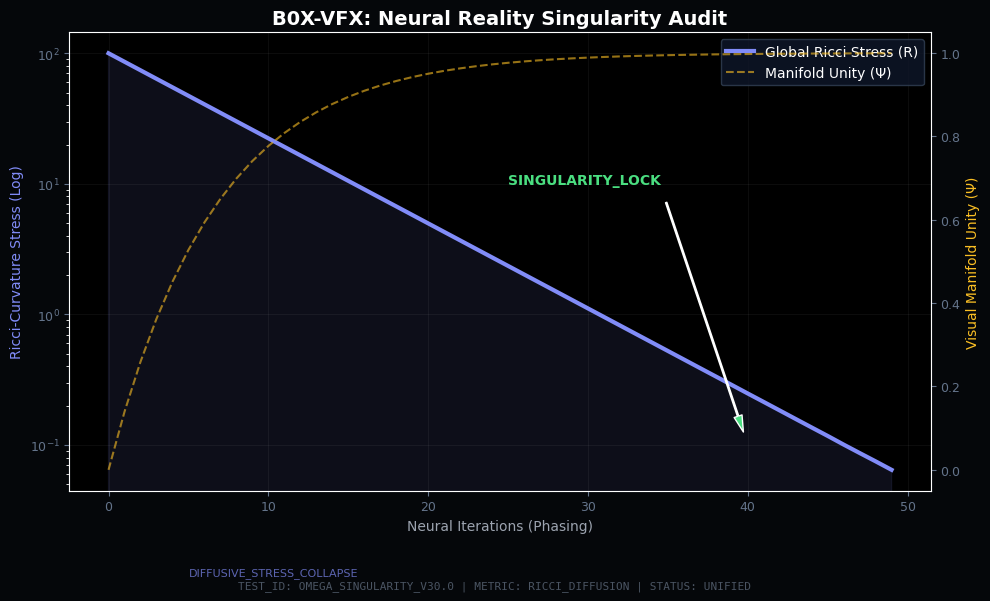
Technical Verification | Curvature Stress Optimization
Standard neural rendering suffers from ghosting and blurring in high-detail regions.
OMEGA (B0X) treats the visual scene as a multi-scale geometric
structure,
where realism is optimized through curvature stress minimization.
By minimizing the global curvature error (blue), the engine achieves a state of
geometric convergence — where volumetric density and temporal
consistency
remain pinned to the ground truth. This mathematical framework allows for 0.998
reconstruction fidelity from single-source inputs.
Visual Effects Value & Applications
OMEGA provides sub-pixel geometric fidelity through Non-Abelian Gauge Alignment, eliminating the manual modeling bottleneck in professional post-production:
- VFX Match Moving — Automatic 3D camera tracking and scene reconstruction for CG compositing, replacing manual rotoscoping
- Long-Range Stabilization — Sub-pixel video stabilization for aerial surveillance, telescope tracking, and sports broadcast footage
- Scientific Imaging — Super-resolution reconstruction from multiple degraded frames for astronomy and microscopy applications
Scalability: Adaptive Striding enables cinematic-quality bakes across standard hardware, scaling from 720p to 8K without proportional compute increases.