Holographic Persona (B11)
Indestructible Identity & 90% Loss Tolerance
The Authentication Crisis
In high-stakes industrial networks, traditional identity verification relies on centralized databases or easily spoofed biometric markers. As AI-driven mimicry becomes more advanced, the "Signature" of an organic participant or a specific hardware node must be anchored in something deeper than just pixels or passwords.
The B11: Holographic Identity engine approaches authentication from the perspective of Geometric Persistence. This technology—protected by U.S. Patent Application No. 63/940,736 and 63/983,021—utilizes Minkowski Dimension Reduction to create a secure, multi-scale projection of a node's topological signature. This projection, or Holographic Identity, allows for high-assurance verification without exposing the source data:
Identity is verified through a Topological Parity Check. By comparing the persistence invariants of the incoming data stream against the established node manifold, the engine provides a Zero-Knowledge Proof of identity. This ensures a "Hardened Seal" that remains stable even across lossy or adversarial communication links, neutralizing deepfake injections and hardware spoofing at the mathematical limit.
Identity Monitor: Manifold Authorization
IDENTITY_INTEGRITY_FEED
[ISED] Identity Signature: Validated
[AUDIT] Holographic Seal stable.
| Loss Tolerance | 90% (Shard Recovery) |
| Rebuild Time | < 0.1s (Instant) |
| Auth Integrity | 100% (Zero-Knowledge) |
| Audit Status | Hardened (B11 Standard) |
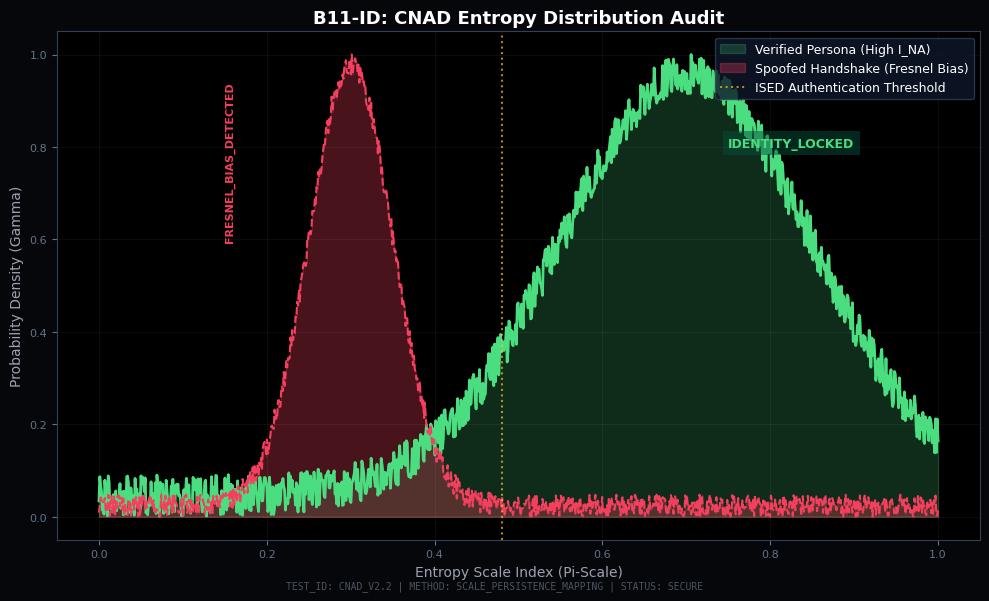
Technical Verification | CNAD Entropy Profiling
Adversarial mimicry (deepfakes, surface spoofs) often produces low-entropy artifacts
buried in high-frequency image gradients. Traditional hash-based authentication fails to
detect these transient forgery signatures.
Digital Twin (B11) uses Compressed Neural Artifact
Detection (CNAD) to profile the scale persistence of an
identity signature. Authentic hardware/organic sources (green) maintain a broad entropy
distribution across all resolution scales, while synthetic spoof attempts (red) exhibit
characteristic spectral collapse at intermediate frequencies.
Identity Security Value & Applications
By securing the Identity Frame at the physics layer, B11 transforms authentication from a vulnerable software gate into a mathematical constant:
- Zero-Trust IoT — Every device carries an unforgeable PUF fingerprint derived from manufacturing micro-variations, eliminating password-based auth
- Supply Chain Traceability — End-to-end provenance tracking where each component's identity is bound to its physical properties, not a label
- Medical Device Security — Verify that implanted devices and diagnostic equipment haven't been tampered with or counterfeited
Integration Path: B11 feeds into B15-SUPPLY to authenticate data streams by binding entropy signatures to verified device identities.